
Introduction
In June 2005, Aaron Freeman, on NPR's All Things Considered stated the following in what has come to be known as a "Eulogy from a Physicist":
“You want a physicist to speak at your funeral. You want the physicist to talk to your grieving family about the conservation of energy, so they will understand that your energy has not died. You want the physicist to remind your sobbing mother about the first law of thermodynamics; that no energy gets created in the universe, and none is destroyed. You want your mother to know that all your energy, every vibration, every Btu of heat, every wave of every particle that was her beloved child remains with her in this world. You want the physicist to tell your weeping father that amid energies of the cosmos, you gave as good as you got.
And at one point you'd hope that the physicist would step down from the pulpit and walk to your brokenhearted spouse there in the pew and tell him that all the photons that ever bounced off your face, all the particles whose paths were interrupted by your smile, by the touch of your hair, hundreds of trillions of particles, have raced off like children, their ways forever changed by you. And as your widow rocks in the arms of a loving family, may the physicist let her know that all the photons that bounced from you were gathered in the particle detectors that are her eyes, that those photons created within her constellations of electromagnetically charged neurons whose energy will go on forever.
And the physicist will remind the congregation of how much of all our energy is given off as heat. There may be a few fanning themselves with their programs as he says it. And he will tell them that the warmth that flowed through you in life is still here, still part of all that we are, even as we who mourn continue the heat of our own lives.
And you'll want the physicist to explain to those who loved you that they need not have faith: indeed, they should not have faith. Let them know that they can measure, that scientists have measured precisely the conservation of energy and found it accurate, verifiable and consistent across space and time. You can hope your family will examine the evidence and satisfy themselves that the science is sound and that they'll be comforted to know your energy's still around. According to the law of the conservation of energy, not a bit of you is gone; you're just less orderly."
I first heard these eloquent thoughts at a friends funeral. Since then, I have wanted to delve deeper into understanding how these concepts apply to life, death, and what happens hereafter. So, let's do that deep dive.
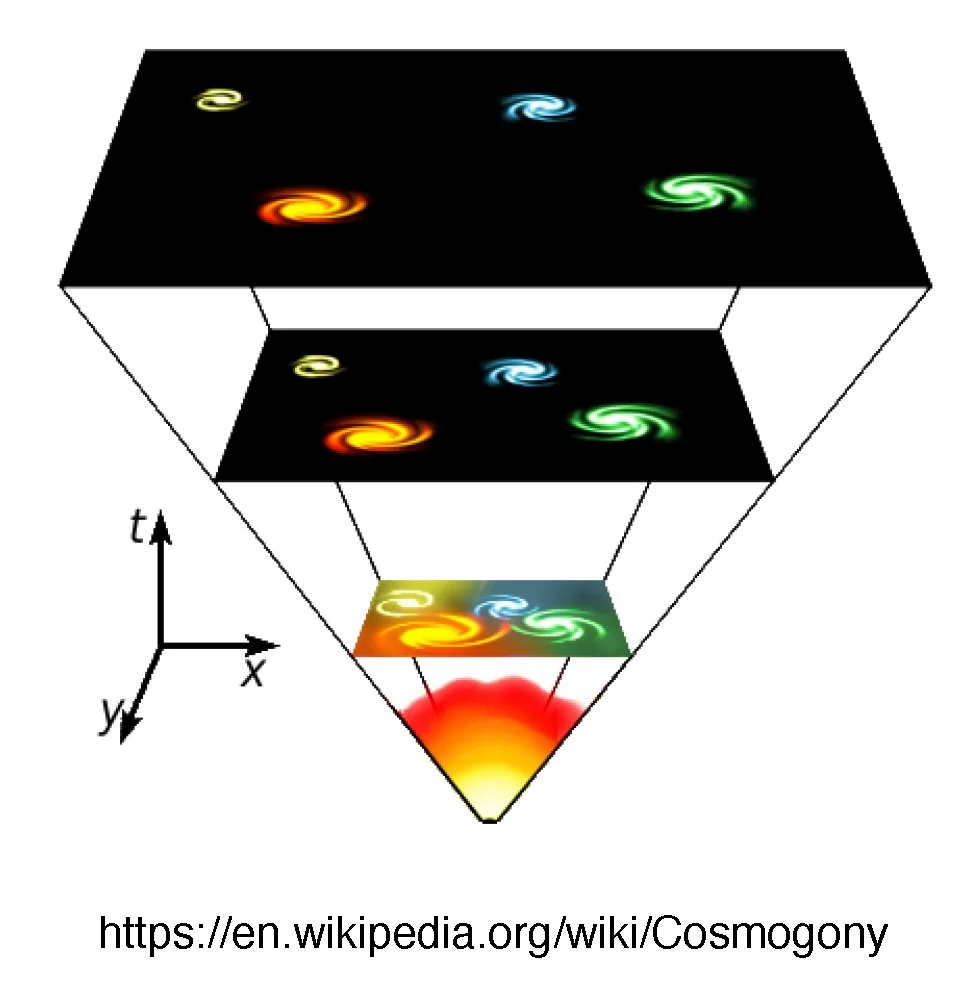
In the beginning according to the "Big Bang" theory, in an event known as the "singularity", the creation of the universe began, a very short phase of intense energy expansion. The expansion was so immense and fast that all pre-existing matter was diluted and replaced by particles of energy that emerged from that singularity; this was the first phase in the creation of the universe.
Approximately 13.8 billion years ago an initially homogeneous entity comprised of infinitely dense energy, and according to Steven Hawkins with no time element, the universe began; immediately, it started to expand and cool. Applying the element of time to events, physicists estimate that this infinite energy source started to coalesce within one microsecond into the first known particles, neutrons, protons, and electrons. These particles then formed the nuclei for hydrogen (H) and helium (He) within 3 minutes of the singularity. Approximately 380,000 years later, the first atoms formed. 200 million years later the first gases, primarily hydrogen and helium in their molecular form, were created. These first molecules, present in enormous volumes, coalesced into the first stars that became the galaxies 400 million years later. Chapters 2 and 3 delve into this in detail.
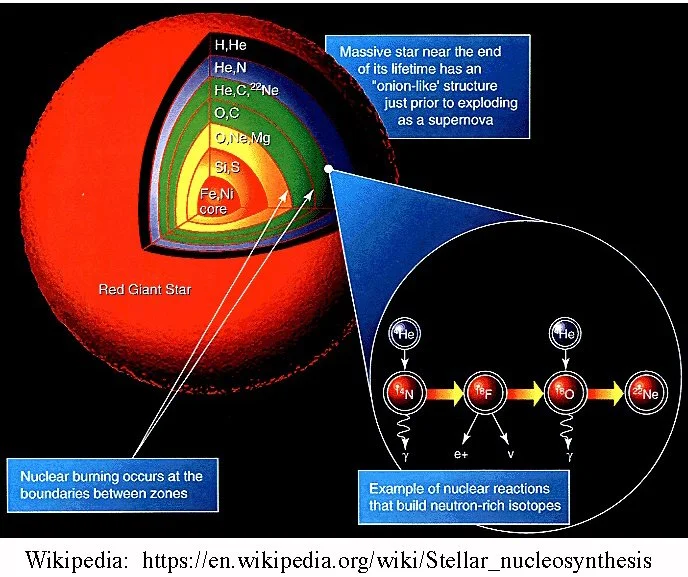
Key to this story is the formation of elements. Within stars, hydrogen (H) and helium (He) underwent fusion to form the elements important to life: Carbon (C), Nitrogen (N), Oxygen (O), and Iron (Fe), to name just a few. Over millions of years, as stars disintegrated, these elements were released into the universe. They became integral parts of matter that distributed widely in the form of gases, liquids, and crystals that condensed into asteroids and comets that facilitated the creation of planets. Over many more millions of years, planets such as earth concentrated large quantities of elements such as iron, silicon, nickel, sulfur, oxygen, and carbon in their inner core.
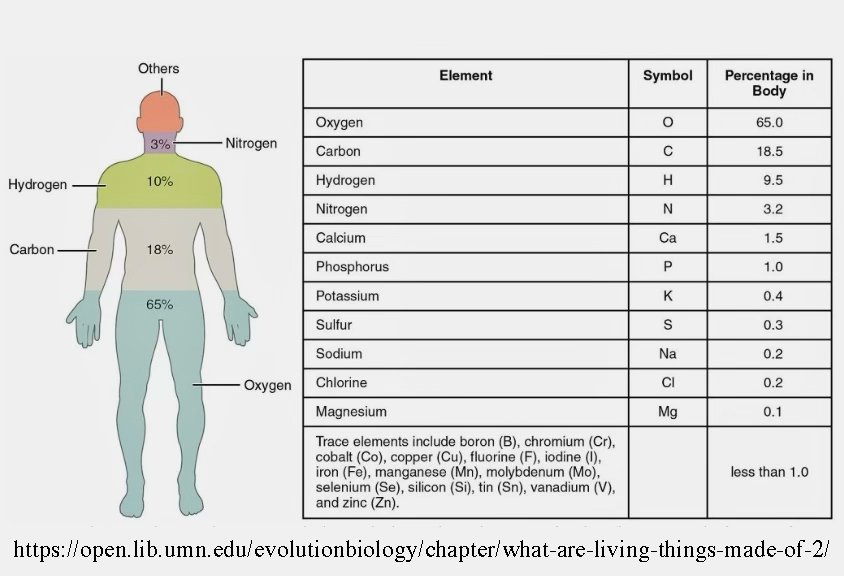
Biological organisms are comprised of numerous elements. Oxygen (O) is the most prevalent, with Carbon (C), Hydrogen (H), Nitrogen (N), Calcium (Ca), and Phosphorous (P) of significant presence. Important biological molecules such as glucose are comprised of C, H, and O.
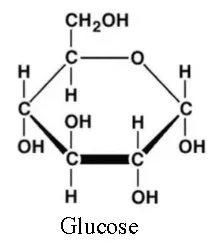
Other important molecules may also include N, P, and S. Potassium (K), sodium (Na), chlorine (Cl), and magnesium (Mg) are important elements in biological fluids to maintain turgor (body pressure) and serve as important intercellular signaling factors (such as heart beat). There are many important multi-element molecules such as glucose.
How did life evolve?
What happens in death?
Decomposition causes breakdown of biological molecules from all living matter facilitating release of these same elements created eons ago into the environment where they are again taken up to become integrated into a future generation of the universe.
What does this all mean from a philosophic/religious point of view. Some believe that the Big Bang followed by the billion year-long process of creating the universe was Gods way of creating life; a bit longer process than was projected in the Bible, but still a meaningful process that resulting in the life we know. And death is God's way of assuring that our essence is preserved in the energy described in the "Eulogy from a Physicist" to be retained and shared by all generations; perhaps in what some consider to be heaven.
